Solar Pool Covers: Free Heat You Get to Keep
A bubble-type solar cover traps the sun’s warmth in your water, holds it through the night and trims what you spend on water, chemicals and electric heating. This guide explains the science, the specs that matter and how to fit and care for one.
When people talk about warming a pool, the conversation usually jumps straight to equipment: heat pumps, gas heaters, rooftop solar panels. At our branches we often steer it somewhere else first. Before you pay to put heat into the water, make sure you’re not throwing away the warmth the sun already gives you for nothing. That’s the job of a solar cover, and it’s the first upgrade we suggest to nearly every pool owner who walks in.
Like it or not, your pool already behaves like a giant solar collector. Whether it’s a bright Highveld afternoon in Pretoria or a clear day in the Western Cape, the water absorbs most of the sunshine that falls on it. Trouble starts at sunset. The warmth begins draining out of the water straight away, and by the time you wake up most of yesterday’s gain has disappeared. Every morning, the pool starts over.
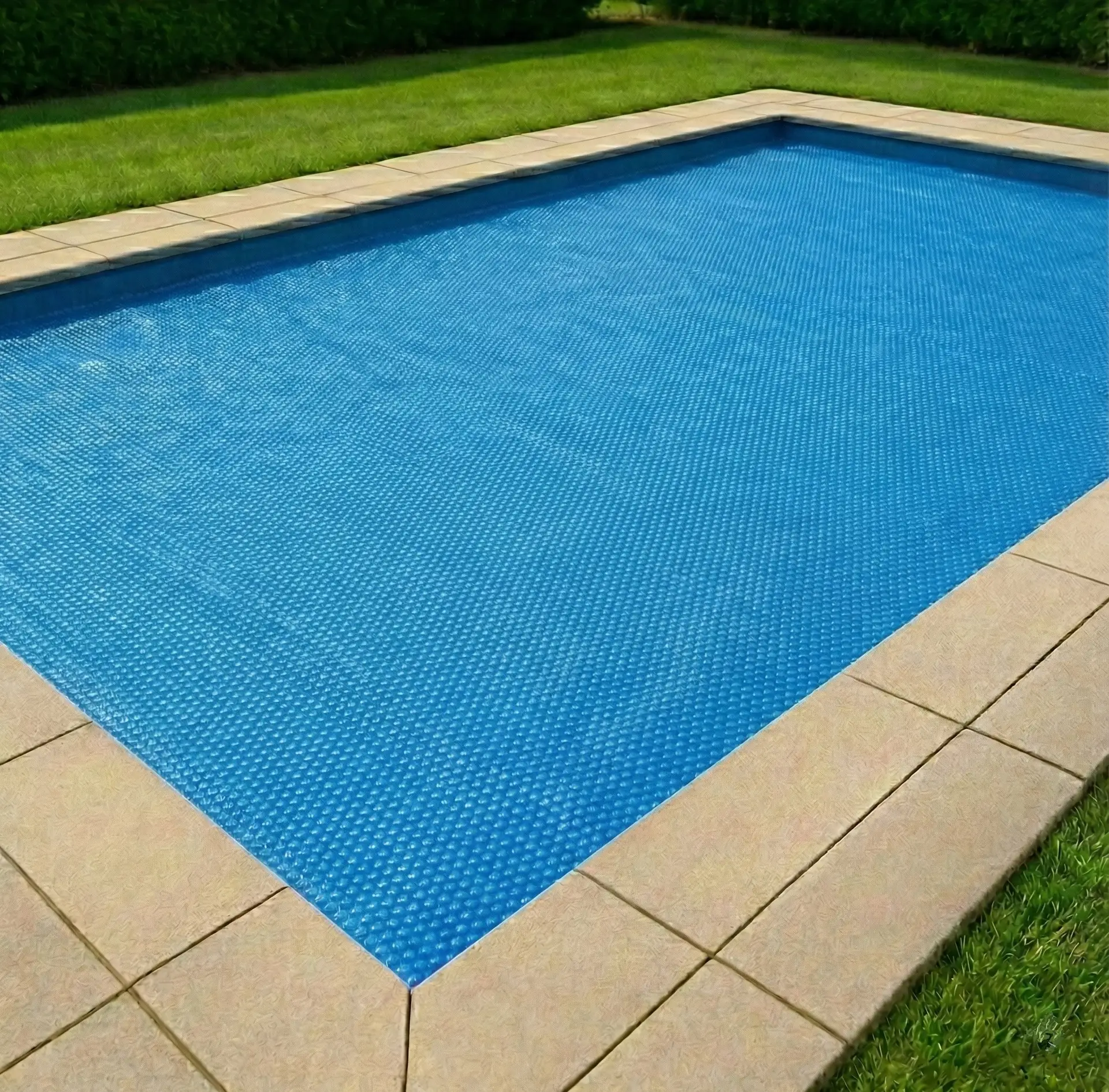
A solar cover interrupts that daily reset. Sunlight passes through it while the sun is up, and after dark it acts as a lid that keeps the gained warmth in the pool. String a few sunny days together with the cover on each night and the water temperature steadily rises, without a heater and without a cent in running costs.
Evaporation: the hidden drain on your pool’s warmth
A pool sheds heat through three routes: conduction through the floor and walls, radiation and convection into the air above, and evaporation from the surface. Evaporation outweighs the other two by a wide margin. Each litre that turns to vapour carries off a large amount of energy, the same effect you feel when you step out of the water into a breeze and start shivering.
What an open pool is costing you
Sources: US Department of Energy, the US EPA WaterSense programme and an evaporation study by the National Plasterers Council. Real-world results depend on wind exposure, shade and how faithfully the cover goes on.
That’s how a thin plastic sheet manages such a big effect. Because the cover lies directly on the surface, moisture has no air gap to escape into. Stop the evaporation and you’ve plugged the single largest leak in the whole system.
What temperature gain can you expect?
On a pool with no heating at all, a properly fitted solar cover used nightly will usually keep the water 6°C or more warmer than the same pool left uncovered. In a sunny, sheltered garden that figure can climb to 10°C. In practice, that’s what separates an October pool you only admire from one you actually get into.
Keep two points in mind. The effect builds up over time: a cover doesn’t heat water the way a heater does, it simply stops it cooling, so each day starts from where the previous one ended. Allow three to five days of sunshine before you decide whether it’s working. And the cover only works when it’s actually on the water. Left rolled up beside the pool overnight, it achieves nothing, which is exactly why a roll-up station matters (more on that below).
Heaters put warmth into the water. A cover stops it escaping. Use both and you’ll have the warmest pool at the lowest cost.
Why heat pump and solar panel owners gain the most
It may seem counter-intuitive, yet the pool owners who get the biggest return from a solar cover are usually those who have already spent money on heating. The reasoning is simple.
A heat pump is an efficient machine, but on an uncovered pool the degrees it adds by day bleed away by night. The next day it must rebuild all that lost heat, so you end up paying for electricity to warm the same water twice over. With a cover on overnight, the heat pump only needs to make up the small loss, which means shorter running times, a smaller electricity bill and a much quicker climb to your set temperature in spring. If you’re weighing up a unit, our heat pump buying guide explains how efficiency (COP) works.
Solar panels follow the same principle. They harvest free energy, but only during daylight hours. On an open pool, most of what a good sunny day delivered has gone by sunrise; with a cover, you hold on to what the panels collected. Plenty of owners discover that panels and a cover together keep the water at a comfortable swimming temperature without any powered heating at all.
- Shorter heat pump running hours It keeps the water at temperature rather than rebuilding it daily
- Solar panel gains stay in the pool Night-time losses fall sharply, so every morning starts warmer
- An earlier start to swimming season Hit your target temperature in days instead of weeks
- A smaller heater is enough With less heat escaping, there’s no need to oversize the system
Savings beyond the heating bill
Lower chemical use
Direct sunlight works against your chlorine. Its UV rays break down free chlorine rapidly, which is why an open pool in mid-summer can use up its chlorine in one afternoon. While it’s in place, a solar cover shields the water from UV and also stops chlorine escaping from the surface with the evaporating water. According to the US Department of Energy, covering a pool cuts chemical use by 35–60%. That means fewer top-ups, fewer shopping runs and steadier water balance.
Less topping up with the hosepipe
In hot, windy weather an open pool can drop several centimetres a week through evaporation, something owners in breezy spots like the Cape and the Namibian interior will recognise. Every centimetre has to be replaced, and that fresh water then has to be balanced and treated, so you pay twice. Reduce evaporation by roughly 95% and you’ll find the hosepipe stays coiled most of the time.
A cleaner pool with less effort
Leaves, dust, bugs and pollen settle on top of the cover rather than in the water. Rinse them off before you roll it back and the pool stays cleaner, the filter goes longer between backwashes and your pool cleaner has a lighter workload. If your garden has trees overhanging the pool, that benefit alone may cover the cost.
Choosing a cover: three specs that matter
Bubble covers vary a lot in quality. Three factors decide how well one performs and how many seasons it will survive.
Material thickness. Thickness is quoted in microns, where one micron equals a thousandth of a millimetre. Budget covers are frequently in the 300–400 micron range, and under harsh African sun they tend to turn brittle and lose bubbles within a season or two. A 500 micron cover, which is half a millimetre thick, traps more air, insulates more effectively and resists UV and chlorine for much longer.
Lamination. Double-laminated material consists of two layers bonded into one sheet instead of a single layer. That bond makes the bubbles far less prone to splitting or separating, which is how cheaper covers typically give up.
Bubble construction. The bubbles provide the insulation. In a multi-bubble pattern each cell is subdivided instead of being one large dome, so it holds more air and keeps its shape better under heat and load than a basic single bubble.
Recommended cover
TriTherm Solar Pool Blanket, 500 Micron
The TriTherm is made from double-laminated 500 micron material with a tri-bubble layout and SunSorb™ technology, designed to absorb the sun’s energy and pass it into the water instead of bouncing it off. It’s rated for a heat gain of up to 10°C and is offered in a choice of pre-cut sizes for standard pool shapes, with custom sizes available on request. Ask your nearest branch for trade pricing.
- Double-laminated, 500 micron
- Insulating tri-bubble design
- SunSorb™ heat-absorbing technology
- Heat gain of up to 10°C
- Can be trimmed to any pool shape
- Pre-cut widths from 3.5m to 4.3m
How to fit a solar cover
Fitting is straightforward, but there’s one step people often get wrong: let the cover sit on the water for a full day before you trim it.
-
Bubbles face the water
Lay the cover with the bubble side down and the flat side up. The bubbles provide the insulation, while the smooth upper surface lets leaves and water slide off.
-
Let it float for a day
Spread the cover over the pool in roughly the right position and leave it in the sun for 24 hours so it can relax and lie flat. It settles and spreads a little, so trimming any earlier risks cutting it too short.
-
Cut it to the edge
With a sharp pair of scissors or a utility knife, trim along the inner edge of the coping so the cover rests just inside the pool. Cut around ladders, steps and the weir opening. Avoid leaving any overlap onto the paving, because it catches the wind and adds nothing.
-
Put it on every evening
The most valuable hours for a cover are from sunset to sunrise. Build covering the pool into your evening routine and you’ll see the difference.
Important: this is not a safety cover
A solar cover simply floats on the surface and cannot hold the weight of a child or pet. If someone falls in while it’s on, it can wrap around them and stop them coming up for air. Never allow anyone to swim beneath it, keep children from playing on or around it, and keep your pool fence and gate properly maintained at all times. If you need a cover for safety, choose a purpose-built safety net or solid cover instead.
Make it a habit with a roll-up station
Here’s what experience teaches about solar covers: the ones that deliver results are the ones people actually use. If taking it off and putting it back is a struggle, it stays off, and a cover that stays off does nothing at all.
Hauling a wet 500 micron cover off a 4m x 8m pool by hand takes two people and usually leaves the cover crumpled on the paving. Bunched up in direct sun with no water underneath to keep it cool, it overheats and deteriorates quickly. A roll-up station solves both issues. One person can wind the cover onto the tube in less than a minute, and once rolled it sits off the ground, out of the way and ready to unroll across the pool at dusk.
The perfect partner
Pool Cover Roll-Up Station with Wheels
Everything comes in the kit: a corrosion-resistant aluminium tube, a handwheel at each end so you can wind from either side, two wheeled stands that let you move the whole unit aside when you have guests, plus all the straps, clips and strap locks needed to attach the cover. Choose from 4.0m, 4.5m and 5.0m lengths, which suit pools up to 3.5m, 4.0m and 4.5m wide respectively.
- Rust-free aluminium tube
- Twin handwheels for one-person operation
- Mobile stands on castors
- Straps and clips supplied
- Three lengths for different pool widths
- Shields the cover from UV and tears
A quick sizing note: because the cover winds onto the tube from one side to the other, the tube must be longer than your pool is wide. For a pool 3.5m wide, you’d choose the 4.0m station. Measure the width before you buy, and bring the measurement to your nearest branch if you’d like help choosing.
Caring for your cover so it lasts
- Store it on the water or on the reel Don’t leave it folded or bunched up on hot paving in the sun
- Remove it when you shock dose Very high chlorine attacks the plastic, so wait until levels are back to normal before replacing it
- Give it an occasional rinse A quick spray with the hose clears dust and chemical build-up
- Protect the reel during long storage Drape a light reflective sheet over the rolled cover if it’s off the pool for weeks
- Check for pooling water on top A little water is normal, but a sagging puddle usually means the cover is cut slightly too big
Solar cover questions we hear at the counter
Will a solar cover keep my pool swimmable in winter?
It will keep the water warmer and cleaner than leaving the pool open, but short, cold winter days on the Highveld or in the Cape don’t deliver enough sunshine to reach swimming temperature on a cover alone. Winter is when a cover really earns its keep alongside a heat pump: the pump provides the heat and the cover holds it. In spring and autumn, a cover by itself can stretch your swimming season by several weeks at each end.
Can my pool cleaner run with the cover on?
Yes. Suction and robotic cleaners carry on working beneath the cover with no trouble, and the weir continues to skim the surface. Just make sure the cover doesn’t block the weir opening.
Could the cover make my pool too warm in summer?
During very hot spells, it can, especially in humid, sunny areas such as the KZN coast or Mauritius. If the water is warmer than you’d like, leave the cover off for a few nights and the temperature will drop quickly. You decide.
Why must the bubbles face down?
The bubbles do the insulating, and they need to touch the water to trap warmth against it. Turned upwards, they gather leaves and water and insulate far less effectively.
What lifespan should I expect from a 500 micron cover?
With good care, meaning it’s stored on a reel, kept off hot paving and taken off during shock treatments, you can realistically expect several seasons. Thinner covers often give out after one or two. Thickness, lamination and storage make far more difference than the brand name printed on it.
Does a cover work on an irregular pool shape?
Yes. Pick the pre-cut size that spans your pool’s longest and widest points, let it float for a day, then trim it to shape. Kidney, freeform and L-shaped pools all work well.
The bottom line
If you only make one change to your pool this season, make it a solar cover. It keeps the sun’s free warmth in the water, slashes evaporation, eases the load on your chlorine and filter, and makes any heat pump or solar panels you already own work far harder for you. Pair it with a roll-up station so it actually goes on every night, and you’ve got the most cost-effective heating upgrade there is.
Not sure which size you need? Pop into any of our 14 Pool Trade branches across South Africa, Namibia and Mauritius with your pool measurements, or call or WhatsApp us on 066 503 7475. Trade and public are welcome.
Warmer water. Smaller bills. Zero electricity.
Visit your nearest Pool Trade branch for trade pricing and same-day supply, or call or WhatsApp 066 503 7475.